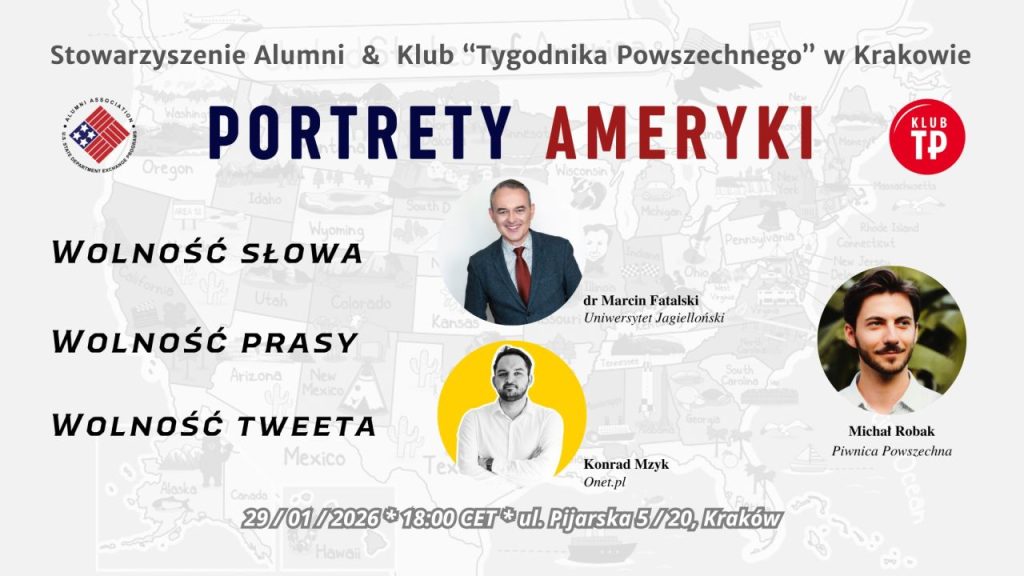
At the first “Portraits of America” meeting of 2026, we talked about freedom. More specifically, about “Freedom of Speech. Freedom of the Press. Freedom of the Tweet.”
We discussed the erosion of the concept of free expression in the 21st century. We talked about the boundaries being crossed in the name of free speech; about the threats facing 21st-century media; about propaganda, manipulation, fake news, and conspiracy theories; and about the digitization of journalism — online media and social media. We considered whether today’s citizens seek in-depth, truthful information, or whether they prefer to feel safe inside their information bubble.
We invited experts in their fields — and, at the same time, experienced researchers of the American social and political system — to join the discussion. Our guests were Dr. Marcin Fatalski from the Jagiellonian University and Konrad Mzyk, editor at Onet.pl. The conversation was moderated by Michał Robak from Piwnica Powszechna.
YouTube: https://youtu.be/p2ZOXbfieXs?si=MqyK3X3vQbsn3mgd
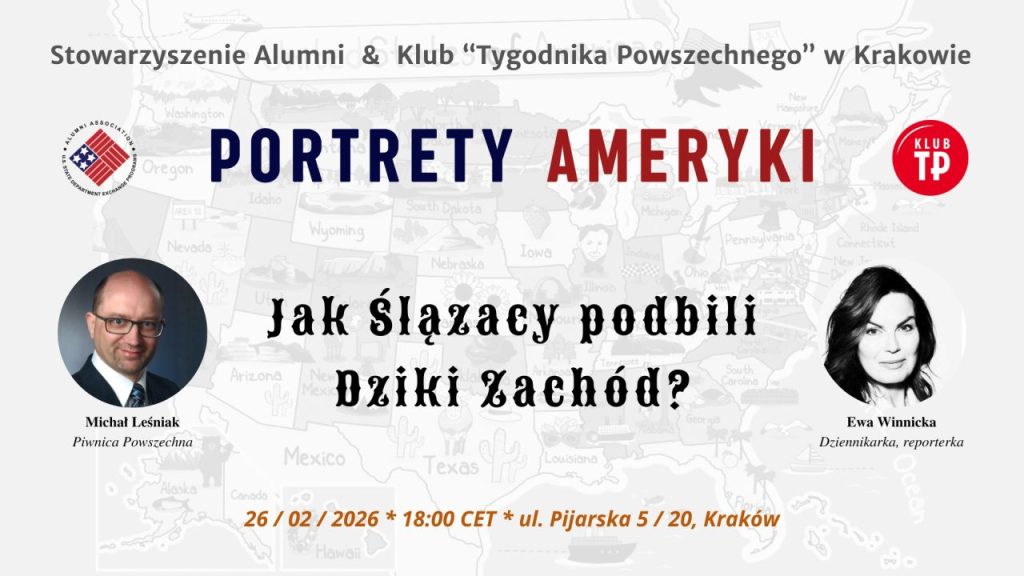
Join us for a special meeting with Ewa Winnicka, author of the book “Miasteczko Panna Maria. Ślązacy na Dzikim Zachodzie” (“Panna Maria: Silesians in the Wild West”).
Did you know that the first Polish settlement in the United States was founded… in Texas? In the mid-19th century, more than four hundred Silesians set sail from Silesia to the port of Galveston in search of “paradise on earth.” They went on to establish settlements such as Panna Maria, Cestohowa, and Kosciusko — places where Polish memory intertwines with American history.
In her work of literary reportage, Ewa Winnicka takes us on a fascinating journey through the lives of these people — from their first steps on the prairie, through the lives of cowboys, ranchers, and pioneers, and the era of wealth brought by the discovery of oil, all the way to the present day, when the descendants of these emigrants are part of the vibrant life of Texas. It’s a story of longing for home, of building an identity, and of a place that became a new homeland for many.
The conversation was moderated by Michał Leśniak.
YouTube: https://youtu.be/nM7LnMx5RaY?si=Aez-Itxbe-GCnTwX
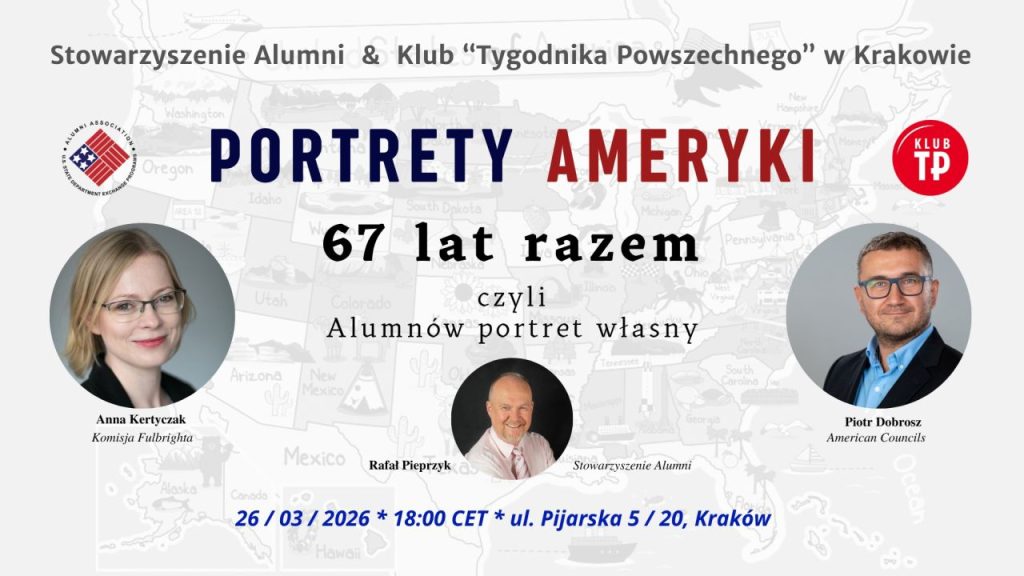
“67 Years Together, or a Self-Portrait of the Alumni.” During this meeting in our series, we listened not only to a conversation with our invited guests, but also to a discussion with the audience. We introduced listeners to the Polish alumni of exchange programs organized and funded by the U.S. government — known as “Alumni” — explaining what these programs are, how long Poles have been able to take part in them, how to “sign up” for them, and what benefits the opportunity to travel to America on one of these programs has brought to Polish Alumni — and not only to them.
We explored these topics and cleared up doubts together with: Anna Kertyczak, Senior Alumni Relations Specialist at the Polish-U.S. Fulbright Commission; Piotr Dobrosz, Managing Director at American Councils for International Education in Poland; and Rafał Pieprzyk, President of the Board of the Alumni Association, which brings together Polish graduates of exchange programs.
YouTube: https://youtu.be/VHA_eabq85w?si=UKFX1P3l43MdgRSZ
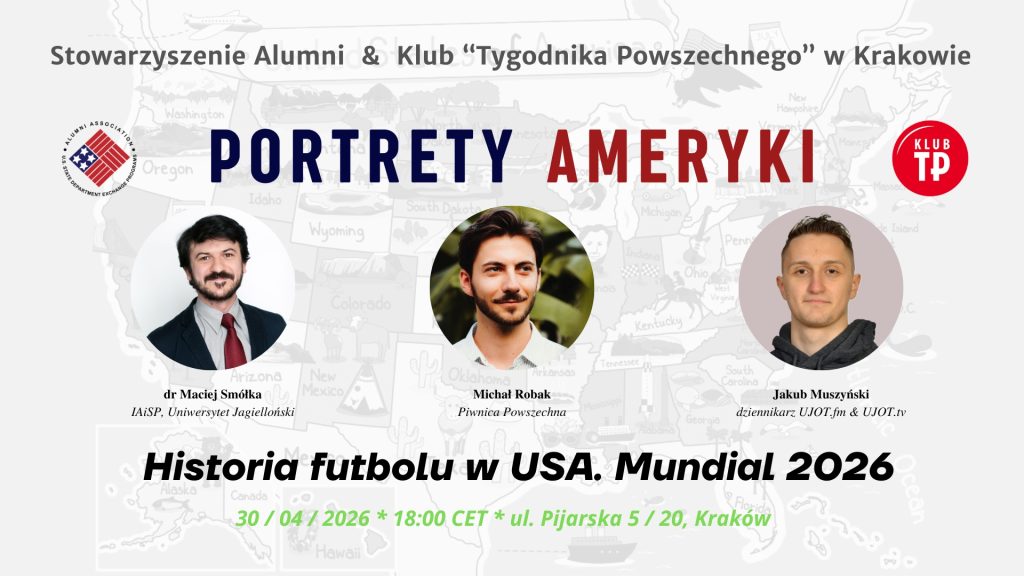
The fourth meeting of 2026 was held under the title “The History of Soccer in the U.S. The 2026 World Cup.”
We took up this topic because of a special moment in U.S. history. First, the United States is celebrating the 250th anniversary of the signing of the Declaration of Independence. Second, in June and July of this year, the United States, Mexico, and Canada hosted the FIFA World Cup. Third, the United States has taken part in the World Cup since the very first tournament, held in 1930. Fourth, right after American football, basketball, and baseball, soccer is the fourth most popular sport in America.
We invited Americanists and specialists in U.S. sports to join the discussion. Our guests were Dr. Maciej Smółka from the Institute of American Studies and Polish Diaspora at the Jagiellonian University, and Jakub Muszyński from UJOT.fm and UJOT.tv.
The conversation was moderated by Michał Robak from Piwnica Powszechna.
YouTube: https://youtu.be/wMJc6aNsJqM?si=HfvsfuMxTzi2GAR1
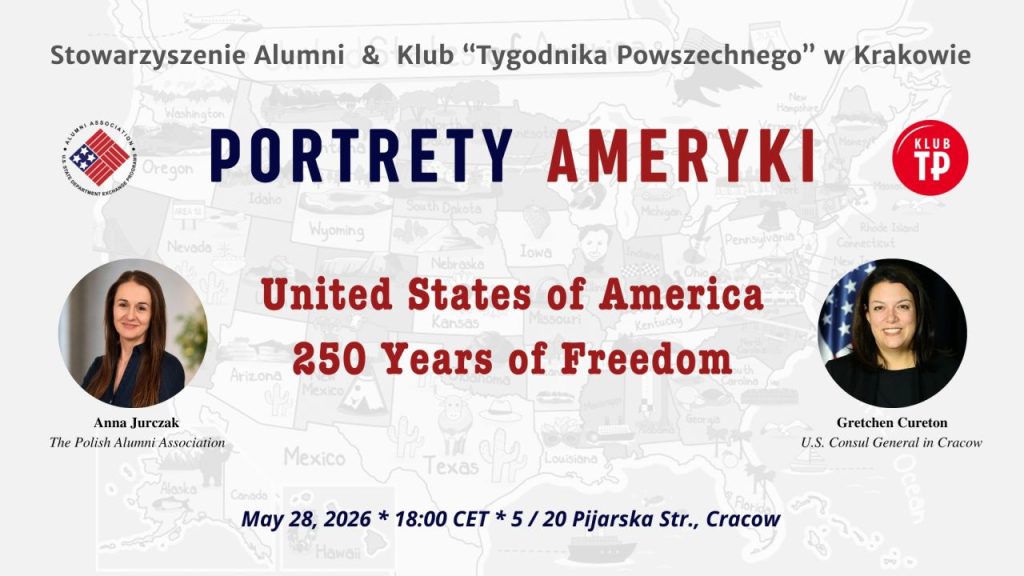
We invited you to a special meeting with Gretchen Cureton, U.S. Consul General in Krakow.
We discussed topics such as: shared values and historical ties between Poland and America, the significance of the 250th anniversary of United States independence, present-day diplomacy in Southern Poland, and her personal connection to Poland.
The conversation were moderated by Anna Jurczak – vise-president of the Polish Alumni Association.
The conversation was held in English.
YouTube: https://youtu.be/CP75qa4TQk4?si=zd4lPtoWZFRdlq-p
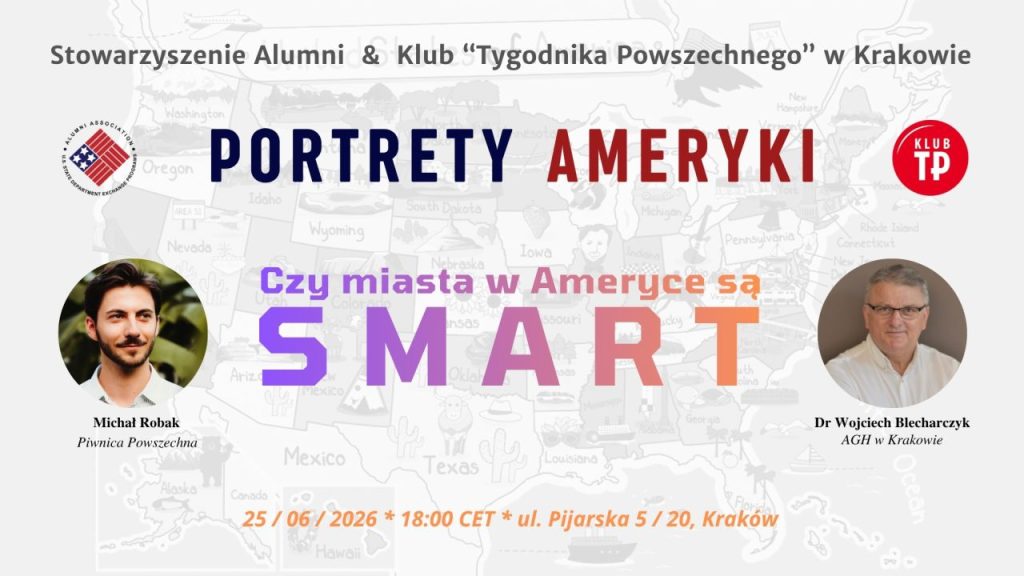
Just before the summer vacation season, as part of the “Portraits of America” series, we talked about American smart cities.
We asked Dr. Wojciech Blecharczyk about smart cities in America. Dr. Blecharczyk holds a doctorate in Earth sciences, is an academic lecturer, and has long promoted the “Smart City – Smart Villages” concept of local government cooperation.
The conversation was moderated by Michał Robak from Piwnica Powszechna.
We asked our guest why the modern “smart city” concept — an approach to urban development based on the principles of sustainable development — is so appealing to society. What is the “Smart City – Smart Villages” concept of local government cooperation? Which smart city models from the U.S. could be adopted in Poland, and could Polish experience in this field be of interest to the rest of the world?